
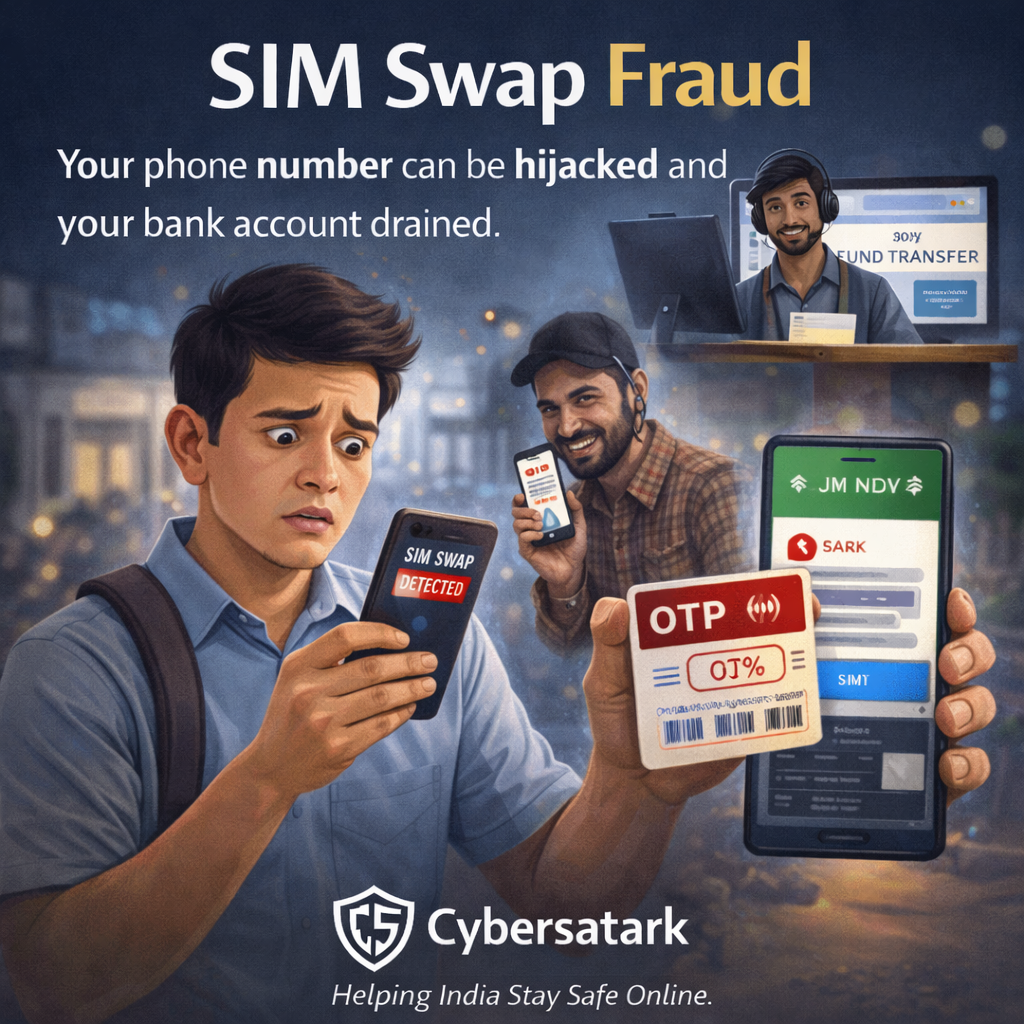
SIM Swap Scams: How Criminals Hijack Your Phone Number and Empty Your Accounts
For most of us, a mobile number is more than just a way to make calls. It is linked to our bank accounts, UPI apps, email IDs, social media, and even government services. Criminals know this very well—and that is exactly why SIM swap fraud has become one of the fastest-growing digital crimes in India.
In 2023–24, Indian banks and telecom operators reported a sharp rise in SIM-related frauds, especially cases where victims lost access to their phones and, within minutes, money disappeared from their bank accounts. What makes SIM swap fraud dangerous is how silent it is—often the victim realizes something is wrong only after the damage is done.
What Is SIM Swap Fraud?
SIM swap fraud happens when a fraudster gets your mobile number transferred to a new SIM card that they control. Once this happens:
- Your phone stops receiving calls and SMS
- The fraudster receives your OTPs
- They reset passwords for banking, UPI, email, and wallets
- Money is transferred out rapidly
The entire process—from SIM swap to account drain—can happen in under 30 minutes.
How Do Fraudsters Pull This Off?
Most SIM swap frauds do not involve hacking technology. They involve social engineering.
Here’s how it usually works:
- Information Gathering
Fraudsters collect basic details such as your name, phone number, Aadhaar/PAN digits, or address. This data often comes from leaked databases, phishing links, fake job offers, or social media oversharing. - Impersonation at Telecom Level
The fraudster contacts a telecom store or customer care pretending to be you. They claim their phone is lost or damaged and request a replacement SIM. - Fake Documents or Insider Gaps
Using forged documents—or exploiting weak verification—the fraudster convinces the telecom operator to issue a new SIM. - OTP Takeover
Once your number is active on their SIM, all OTPs go directly to them. - Financial Attack
They reset banking credentials, approve UPI transactions, and empty accounts.
Real-World Example
In a well-reported case from Mumbai, a working professional lost over ₹12 lakh overnight. His phone showed “No Network” for a few hours, which he assumed was a temporary issue. By the time he contacted his telecom provider, fraudsters had already reset his bank login using OTPs and transferred funds to mule accounts.
This pattern is repeating across cities—Mumbai, Bengaluru, Delhi, Hyderabad—affecting salaried professionals, senior citizens, and even students.
Why SIM Swap Fraud Is So Effective
SIM swap fraud works because:
- OTPs are still widely used as the primary security layer
- Telecom verification standards vary across stores
- Victims ignore early warning signs like network loss
- Fraudsters act extremely fast
According to cybercrime data, mobile-number-linked frauds now account for a significant portion of high-value digital thefts in India.
Early Warning Signs You Should Never Ignore
If you notice any of the following, act immediately:
- Your phone suddenly shows No Signal or Emergency Calls Only
- You stop receiving calls or OTPs
- You receive alerts for password resets you didn’t initiate
- Your UPI or bank app logs you out unexpectedly
Even a 30-minute delay can be costly.
What To Do Immediately If You Suspect SIM Swap Fraud
- Contact Your Telecom Operator First
Visit the nearest store or call customer care to block the SIM and verify if a replacement was issued. - Freeze Bank Accounts and UPI
Call your bank’s fraud helpline and request an immediate freeze. - Change Passwords
Update email, banking, and wallet passwords from a secure device. - Report the Fraud
File a complaint at cybercrime.gov.in or call 1930, India’s national cybercrime helpline.
How to Protect Yourself from SIM Swap Fraud
Prevention is simple but requires awareness:
- Limit personal data sharing on social media
- Avoid clicking unknown links or sharing OTPs—ever
- Use app-based authentication where available
- Add extra security like transaction limits and alerts
- Regularly check if your number is linked to unknown services
- Immediately act on network loss—do not wait
A Final Word from Cybersatark
SIM swap fraud is not a technical failure—it is a trust exploit. Criminals exploit human behavior, weak checks, and delays in response. The good news is that early action can prevent losses, and awareness can stop fraud before it starts.
Your mobile number is your digital identity. Protect it with the same seriousness as your bank PIN.
Stay alert. Stay informed. Stay safe online.